Tracked 3 Family Trips Across 6 Time Zones: How Sleep Apps Kept Us Calm and Connected
You know that exhausted, cranky feeling when the whole family lands after a long flight—everyone’s off rhythm, kids are melting down, and bedtime feels impossible? I’ve been there, too. Last year, we took three big trips across multiple time zones, and at first, disrupted sleep nearly ruined the joy. But then I discovered something simple: using sleep improvement apps didn’t just help us rest better—it helped us actually enjoy our time together. Here’s how tech quietly transformed our family travel.
The Hidden Struggle of Family Travel: It’s Not Just Jet Lag
Let’s be honest—when we plan family trips, we think about flights, hotels, and must-see spots. We pack snacks, chargers, and favorite toys. But what we often forget is the invisible thread that holds everything together: sleep. Without it, even the most magical destination can feel stressful. I remember landing in Tokyo at 6 a.m. with my two kids, only to have my youngest burst into tears by 8 a.m. because the light was too bright, the bed was too firm, and nothing smelled like home. My older daughter, usually curious and cheerful, sat quietly in the corner, overwhelmed and shut down. My husband and I exchanged that look—the one that says, “We traveled halfway around the world, and we’re already too tired to enjoy it.”
This isn’t just about being sleepy. It’s about how disrupted sleep chips away at our emotional reserves. When kids don’t sleep well, they’re more reactive, less patient, and quicker to meltdown. Adults aren’t immune either. We become more irritable, forgetful, and less present. I’ve missed beautiful moments—my daughter laughing at a street performer, my son trying sushi for the first time—because I was too drained to fully engage. The real cost of poor sleep isn’t measured in yawns; it’s in the connections we almost miss. And on family trips, where time is limited and every moment matters, that’s a heavy price to pay.
What surprised me most was how long the effects lasted. It wasn’t just the first night. For days, we were all out of sync—some too wired to sleep, others too groggy to wake up. Bedtime became a battleground. Morning routines felt like uphill battles. We weren’t just adjusting to a new time zone; we were adjusting to a new version of ourselves, one where patience was thin and joy felt just out of reach. That’s when I realized: if we wanted to truly enjoy our trips, we needed to treat sleep not as an afterthought, but as a priority. And that’s where technology quietly stepped in—not to replace our routines, but to support them.
Why Sleep Matters More During Travel—Especially for Kids
Sleep isn’t just about closing your eyes and waking up refreshed. It’s the foundation of how we feel, think, and connect. When we travel, especially across time zones, that foundation gets shaken. Our bodies run on internal clocks—circadian rhythms—that respond to light, routine, and environment. Change any of those, and the whole system can go off track. For adults, that might mean feeling sluggish or unfocused. For kids, the impact is often much more intense.
Children’s brains and bodies are still developing, which makes them more sensitive to disruptions in sleep. A missed nap or a restless night can show up as mood swings, difficulty concentrating, or even physical symptoms like headaches or stomachaches. I saw this firsthand when we visited London. Our plan was to spend the morning at the Natural History Museum—a place my son had been dreaming about for months. But he’d woken up at 3 a.m., unable to fall back asleep, and by 10 a.m., he was so overtired that he refused to get out of the hotel bed. We ended up spending the day in the room, watching cartoons and eating room service pancakes. It wasn’t the adventure we’d imagined.
What I didn’t realize at the time was that his body wasn’t just tired—it was confused. The daylight, the time change, the unfamiliar bed—all of it sent mixed signals to his brain. Without the usual cues, like his bedtime story or the dim hallway light, his body didn’t know when to wind down. And without quality sleep, his ability to regulate emotions and energy was compromised. This isn’t just about missing one activity. Over time, poor sleep during travel can affect memory, learning, and even the way kids remember the trip itself. How many amazing experiences fade into a blur because they were too tired to fully absorb them?
For parents, the challenge is twofold. We’re not only managing our own sleep disruption but also helping our children navigate theirs. And unlike at home, where routines are established, on the road everything feels temporary. That’s why I started looking for ways to bring a sense of stability into our travel days—not through rigid schedules, but through gentle, consistent signals that told our bodies, “It’s okay. You’re safe. It’s time to rest.” That’s when I began exploring sleep apps not as a fix, but as a tool to create comfort in unfamiliar places.
How Sleep Apps Found Their Way Into Our Suitcases
I’ll admit it—I didn’t think sleep apps were for me. When I first heard about them, I pictured people struggling with chronic insomnia, counting sheep on their phones at 2 a.m. That wasn’t us. We didn’t have sleep disorders; we just had life. But then we had a red-eye flight to Vancouver, and everything changed. The kids were wired from the excitement, the cabin lights were flickering, and I could feel the tension building. My daughter kept asking, “Are we there yet?” every ten minutes. My son was kicking the seat in front of him. I knew if we didn’t calm down before landing, the whole day would be off.
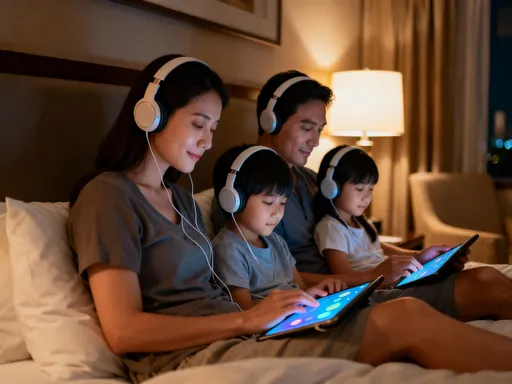
That’s when I remembered an app a friend had mentioned—something with calming sounds and bedtime stories. I downloaded it quickly, hoping for a miracle. I put on the “Ocean Waves” track through my headphones and shared the story feature with the kids using a single pair of kid-friendly earbuds. Within minutes, my daughter’s breathing slowed. My son stopped fidgeting. The story was simple—about a little fox who learns to fall asleep under the stars—but the voice was warm, steady, and soothing. It wasn’t magic, but it was close.
That small moment made me realize something important: sleep apps aren’t just for people who can’t sleep. They’re for anyone who needs a little help finding calm in the chaos. On that trip, we used the app every night—sometimes just for the white noise, sometimes for the breathing exercises, and often for the bedtime stories that made our hotel room feel a little more like home. The kids started asking for it: “Can we use the sleep app tonight?” It became part of our routine, a familiar voice in an unfamiliar place. And for me, it was a reminder that support doesn’t always come from big changes. Sometimes, it’s a gentle sound, a soft voice, or a five-minute breathing exercise that makes all the difference.
What I appreciated most was how unobtrusive it was. This wasn’t about staring at a screen or getting lost in notifications. The apps we used were designed to help us disconnect, not stay glued to our devices. We’d set a timer, listen for 10 or 15 minutes, and then let the phone go dark. It felt less like using technology and more like borrowing a small piece of peace from it.
Matching the Right App to Each Family Member’s Needs
One size does not fit all—especially when it comes to sleep. What works for a six-year-old won’t necessarily help a tired parent or a moody teenager. That’s why we didn’t just pick one app and stick with it. We experimented. We tried different features, different voices, different sounds, until we found what each of us responded to. It wasn’t about perfection; it was about finding what brought a little more calm to each person’s night.
For my younger daughter, the bedtime stories were everything. She loved the animal characters and the soft voices—especially the one that sounded like a panda. “I like the panda voice best!” she’d say, snuggling under the covers. The stories gave her something to focus on, a gentle narrative to follow as her mind wound down. For my son, who’s more sensitive to noise, white noise was the game-changer. The sound of rain or a fan helped block out hallway noises and unfamiliar hotel sounds that used to keep him awake. We’d play it softly through a small speaker, and he’d fall asleep faster than he had in months.
My husband found relief in the breathing exercises. He’s not someone who naturally slows down, but the guided sessions—inhale for four, hold for four, exhale for six—gave him a way to release the day’s stress. “It’s like a reset button,” he told me. “I don’t even realize how wound up I am until I start breathing with the app.” As for me, I leaned into the mindfulness meditations. Five minutes of listening to a calm voice guide me through a body scan helped me let go of the mental to-do list that always follows me into bed.
We even got our teenage niece involved when she joined us on one trip. At first, she rolled her eyes. “An app to help me sleep? Really?” But after one night of using the “focus-to-sleep” mode—where you listen to a story while gradually lowering the volume—she admitted it helped. “I wasn’t expecting to like it,” she said, “but I actually fell asleep faster.” That moment reminded me that even the most skeptical among us can benefit from a little digital support when it’s tailored to our needs.
Syncing Sleep Schedules Before and After Flights—A Game Changer
One of the most powerful things we learned wasn’t just about using sleep apps during travel—it was about using them to prepare for it. Jet lag doesn’t have to hit like a freight train. We discovered that by gradually shifting our sleep times in the days before a trip, we could ease into the new time zone instead of crashing into it. And guess what helped us do that? The same apps we used at night.
Here’s how it worked: if we were flying east, we’d start going to bed 15 minutes earlier each night, using the app’s wind-down routine to signal to our bodies that it was time to sleep. We’d play the same sounds, follow the same breathing pattern, and keep the routine consistent. When flying west, we’d delay bedtime by 15 minutes and use a calming story to help us stay relaxed even if we weren’t tired yet. It wasn’t about forcing sleep; it was about guiding our rhythms.
The real win came when we returned home. Instead of spending three days readjusting, we used the apps to help us shift back gradually. We set gentle reminders, used the same bedtime cues, and gave ourselves permission to rest. The kids didn’t fight bedtime as much because it didn’t feel like a sudden change. It felt like a return to a familiar rhythm.
We started calling it our “family rhythm reset.” No pressure, no strict rules—just small, consistent steps guided by the tools we already trusted. And the difference was noticeable. On our last trip, we landed in Paris on a Monday and were exploring the Louvre by Wednesday—fully awake, fully present. My daughter remembered every painting she saw. My son stayed engaged all day. And I didn’t spend the first half of the trip wishing I were back in bed. That sense of ease didn’t happen by accident. It happened because we gave our bodies the support they needed to adapt.
Beyond the Trip: How These Apps Improved Our Home Routine
Here’s the unexpected part: we never stopped using the apps when we got home. What started as a travel hack turned into a family habit. Back in our daily lives, we noticed that bedtime was calmer, shorter, and more peaceful. The kids didn’t drag their feet as much. They knew the routine—brush teeth, put on pajamas, listen to the app for ten minutes, lights out. It became a signal, not a struggle.
But it went deeper than that. Using the apps helped us talk more openly about how we were feeling. My daughter started saying, “I feel tired, can we use the sleep app early?” instead of melting down at bedtime. My son began recognizing when he was overstimulated and would ask for the white noise even on regular nights. As parents, my husband and I became more aware of our own need for rest. We stopped glorifying being “busy” and started prioritizing downtime. I now use a five-minute meditation before bed to clear my mind. He uses the breathing exercises after work to transition from “dad mode” back to “me mode.”
It wasn’t just about sleeping better. It was about living better. We became more patient, more present, and more connected. Family dinners felt more relaxed. Mornings were less rushed. Even our weekend outings improved because we weren’t starting the day exhausted. The apps didn’t fix everything—life still has its challenges—but they created space for us to handle them with more calm and clarity.
What I love most is that these tools didn’t take over our lives. They didn’t replace our bedtime stories or family rituals. They enhanced them. The app’s voice didn’t replace mine when I read to my daughter—it just filled in when I was too tired, or when we were away from home. It became part of our rhythm, not a replacement for it.
Tech That Serves the Family, Not the Other Way Around
There’s a lot of noise out there about how technology is pulling families apart—how screens distract us, how devices isolate us, how we’re losing touch with real connection. And yes, that can happen. But my experience has taught me that technology doesn’t have to be the enemy. When used with intention, it can actually bring us closer.
The sleep apps we used didn’t fix every problem. They didn’t stop my son from getting sick on the plane or prevent my daughter from losing her favorite stuffed animal in Madrid. But they did something quietly powerful: they gave us rest. And from that rest, we found patience. From patience, we found presence. And from presence, we found joy.
On our last trip, I’ll never forget sitting on a hotel balcony in Lisbon, watching the sunset with my family. The kids were calm, my husband was smiling, and for the first time in a long time, I wasn’t thinking about what I needed to do next. I was just there. Fully. Completely. And I realized that the app we’d used that morning to help us wake up gently hadn’t just helped us sleep better—it had helped us live better.
Technology, at its best, shouldn’t demand our attention. It should give us back time, space, and peace. These small tools didn’t make our trips perfect, but they made them more enjoyable, more connected, and more memorable. And in the end, isn’t that what family travel is really about? Not ticking off every sight, but savoring the moments we share. With a little help from tech, we learned how to rest well—so we could love well, laugh well, and live well, together.